Leather jackets have been a wardrobe staple across Europe for decades from the rider jackets of London and Berlin to the classic biker styles worn across Milan, Paris, and Amsterdam. But not everything marketed as a “leather jacket” is made from real hide, and one of the most misunderstood materials on the European market today is bonded leather. Shoppers across the UK, Germany, France, Italy, Spain, and the Nordics increasingly come across this term without knowing what it actually means, how it holds up in European weather, or whether it’s a smart buy compared to genuine leather.
At Lammberg, we work with customers across Europe who want honest guidance before they spend their money. This guide covers bonded leather jackets in full detail: what the material is, how it’s made, how it performs in European climates, how EU labelling rules apply to it, and whether it’s worth choosing over genuine leather.
What Is Bonded Leather?
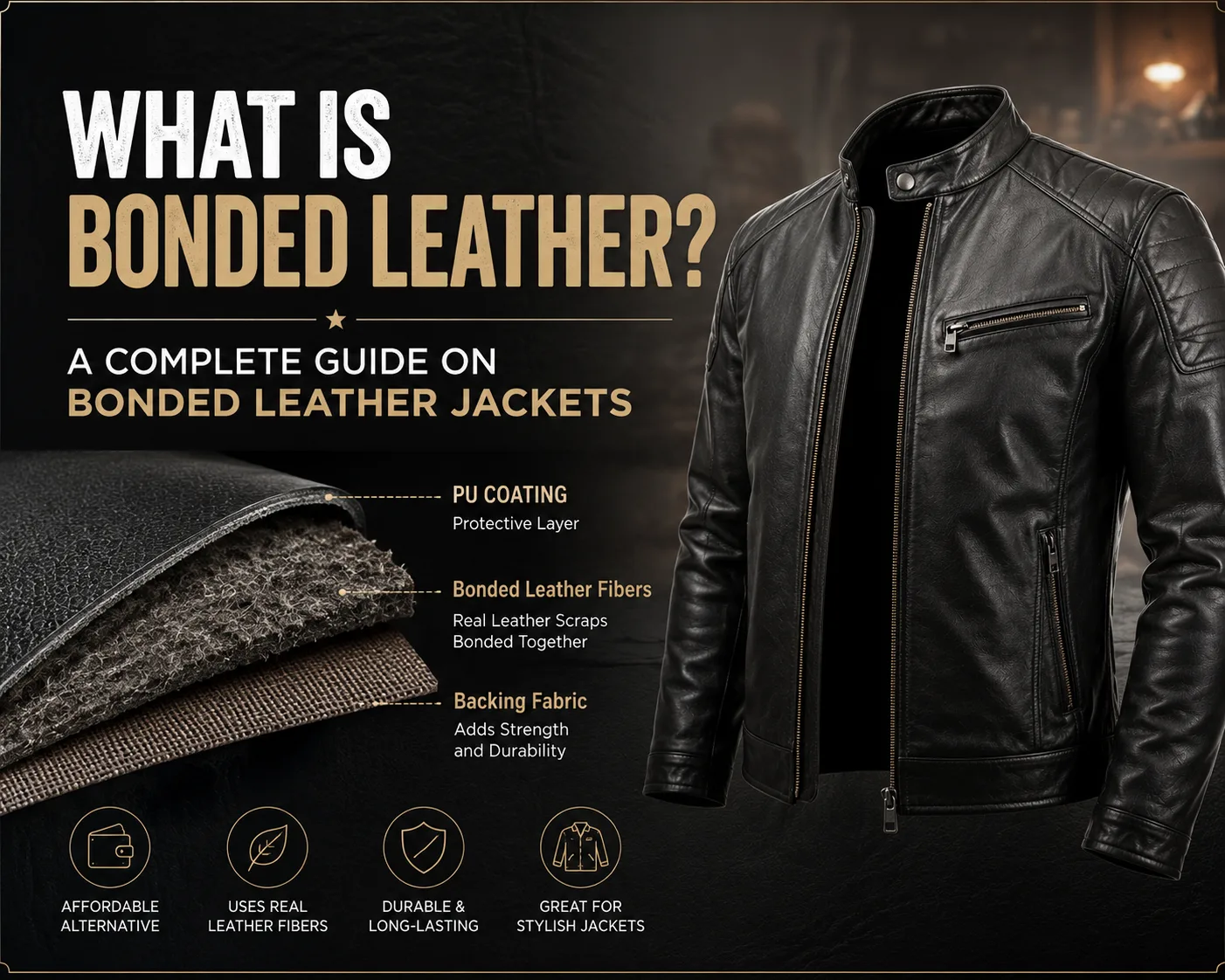
Bonded leather is not leather in the traditional sense it’s a manufactured composite material. It’s created by collecting leftover scraps, shavings, and dust left over from real leather production, grinding that material into a fine pulp, and binding it together with polyurethane or latex onto a fabric or paper backing. The surface is then embossed with a grain pattern to visually mimic natural hide.
Here’s the part most buyers don’t realise: bonded leather typically contains only around 10% to 20% actual leather fiber. The rest is synthetic binder and backing material. It’s also sold under other names reconstituted leather, blended leather, or composition leather all referring to the same basic manufacturing process.
How Bonded Leather Jackets Are Made
The manufacturing process generally follows these steps:
- Leather scraps and offcuts are collected from tanneries and leather-goods factories.
- These scraps are shredded and ground down into a fine pulp or fiber.
- The pulp is mixed with polyurethane or a similar adhesive binder.
- This mixture is spread evenly onto a fabric or paper backing sheet.
- The surface is embossed to recreate the texture and grain pattern of natural hide.
- The finished bonded-leather sheets are cut and stitched into jackets and other products.
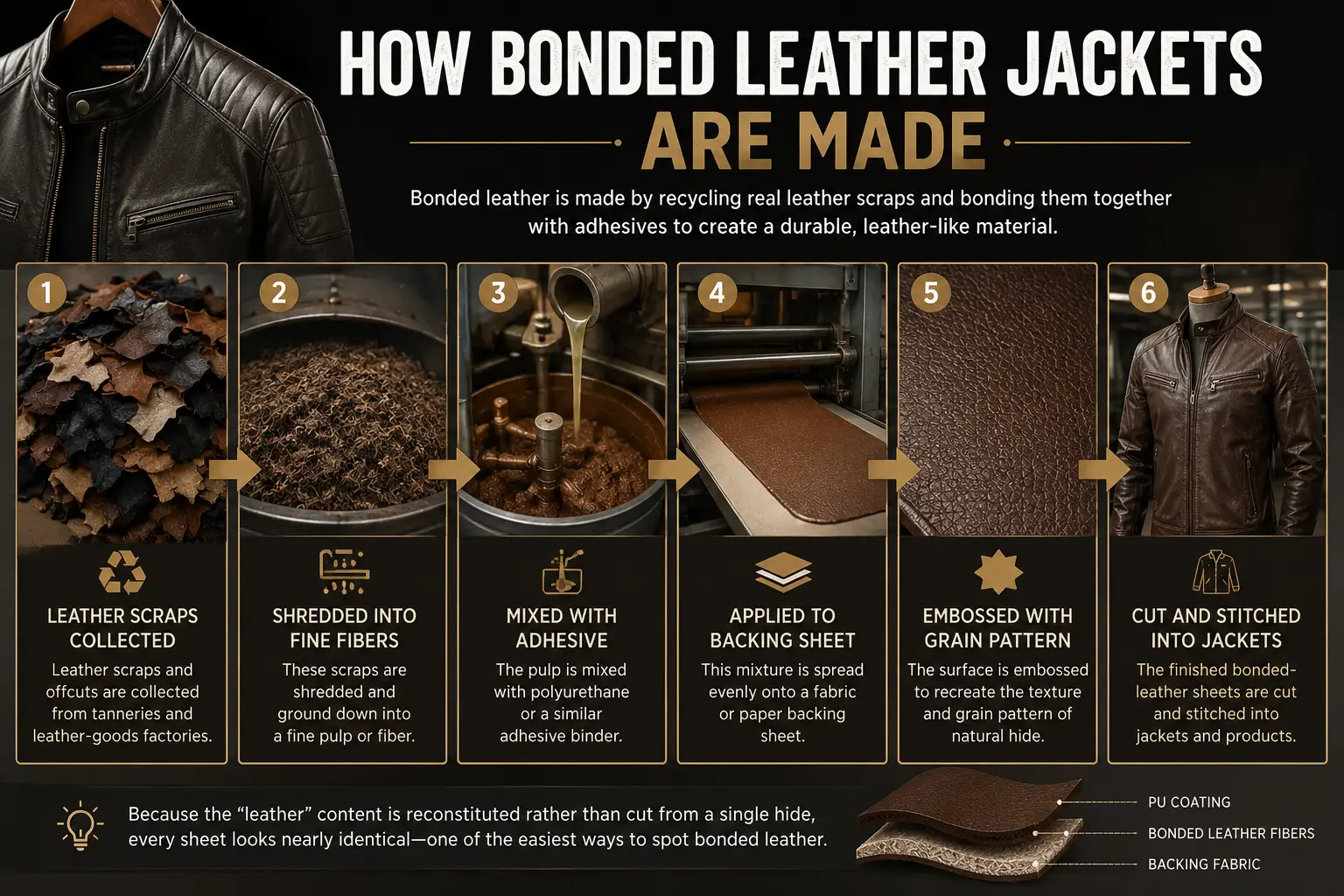
Because the “leather” content is reconstituted rather than cut from a single hide, every sheet looks nearly identical which is one of the easiest ways to spot bonded leather once you know what to check for.
Bonded Leather vs. Full-Grain Leather Jackets
| Factor | Bonded Leather | Full-Grain Leather |
|---|---|---|
| Durability | Peels and cracks within 1–3 years of regular wear | Lasts decades with proper care |
| Appearance | Uniform, machine-perfect grain pattern | Natural imperfections, unique markings per hide |
| Feel | Smoother, sometimes plasticky | Rich, supple, softens with age |
| Smell | Little to no smell, or a chemical odor | Distinct, organic leather scent |
| Ageing | Doesn’t develop patina; degrades instead | Develops a rich patina and character over time |
| Repairability | Very difficult to repair once it peels | Can be conditioned, polished, and restored |
| Performance in cold/wet climates | Coating stiffens and cracks faster in cold, damp conditions | Handles cold and damp European winters far better |
| Price | Budget-friendly | Higher upfront investment, better long-term value |
Lammberg’s New Full-Grain Leather Jacket Collection:
-

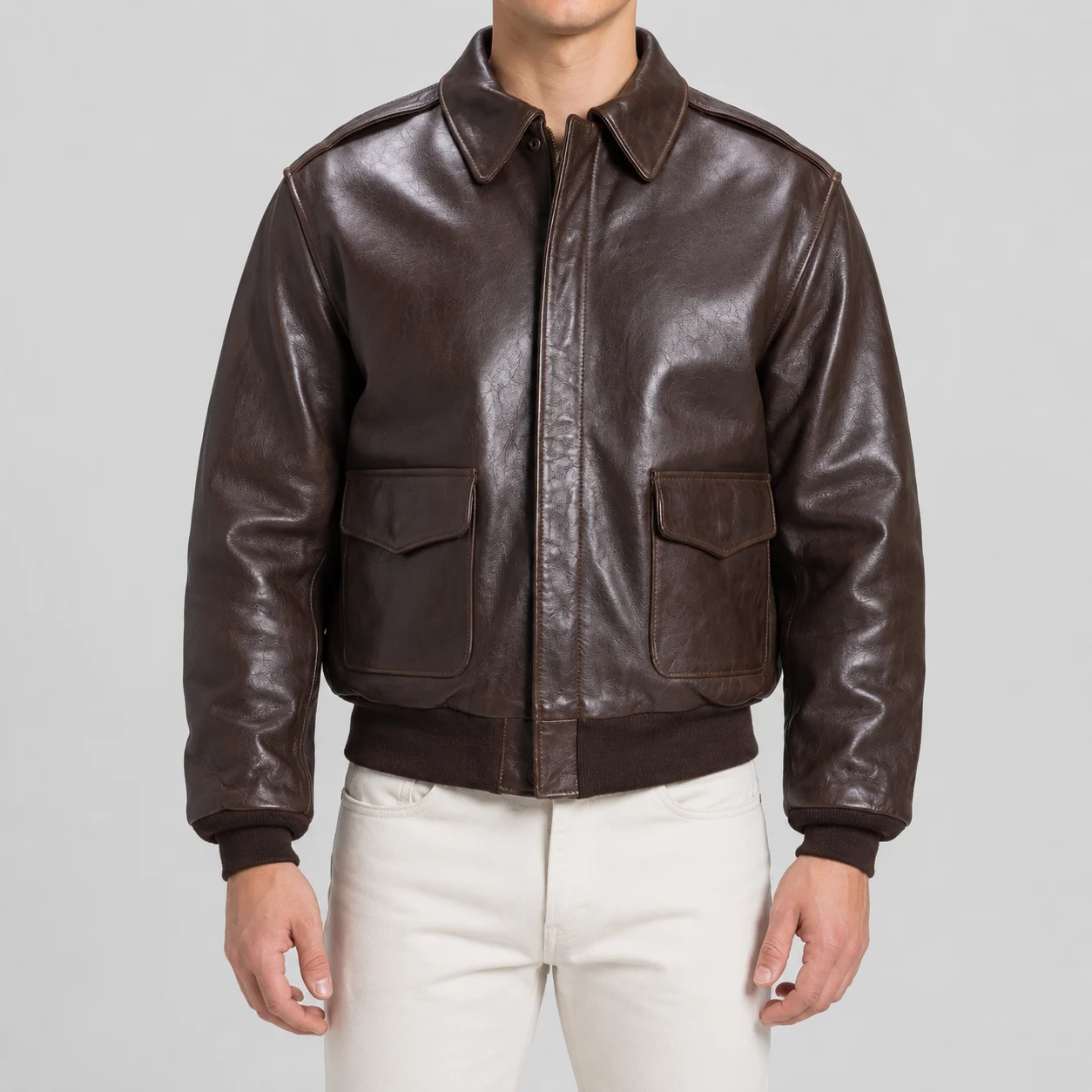
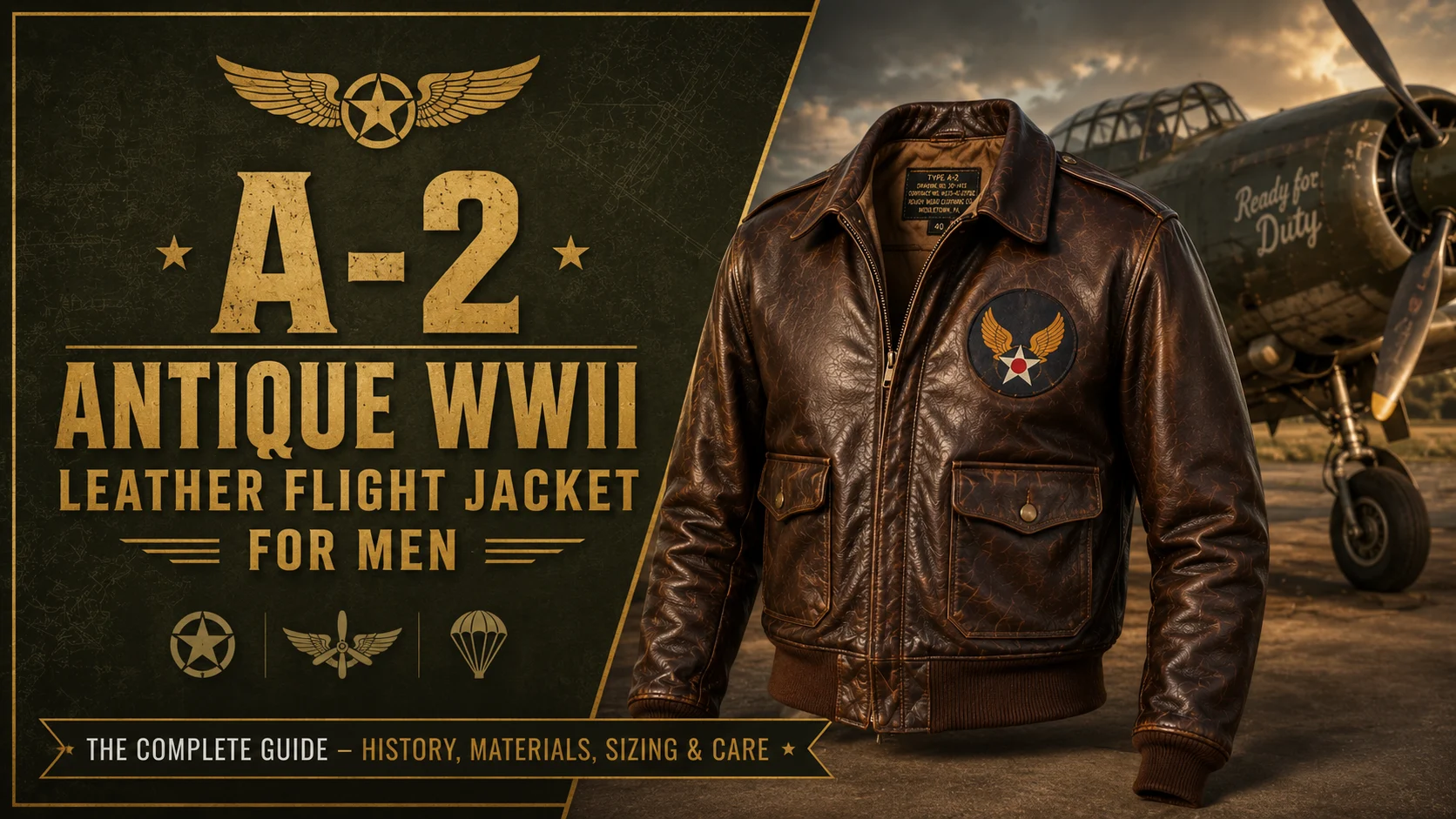
A-2 Antique WWII Leather Flight Jacket For Men
Price range: $299.00 through $329.00 -

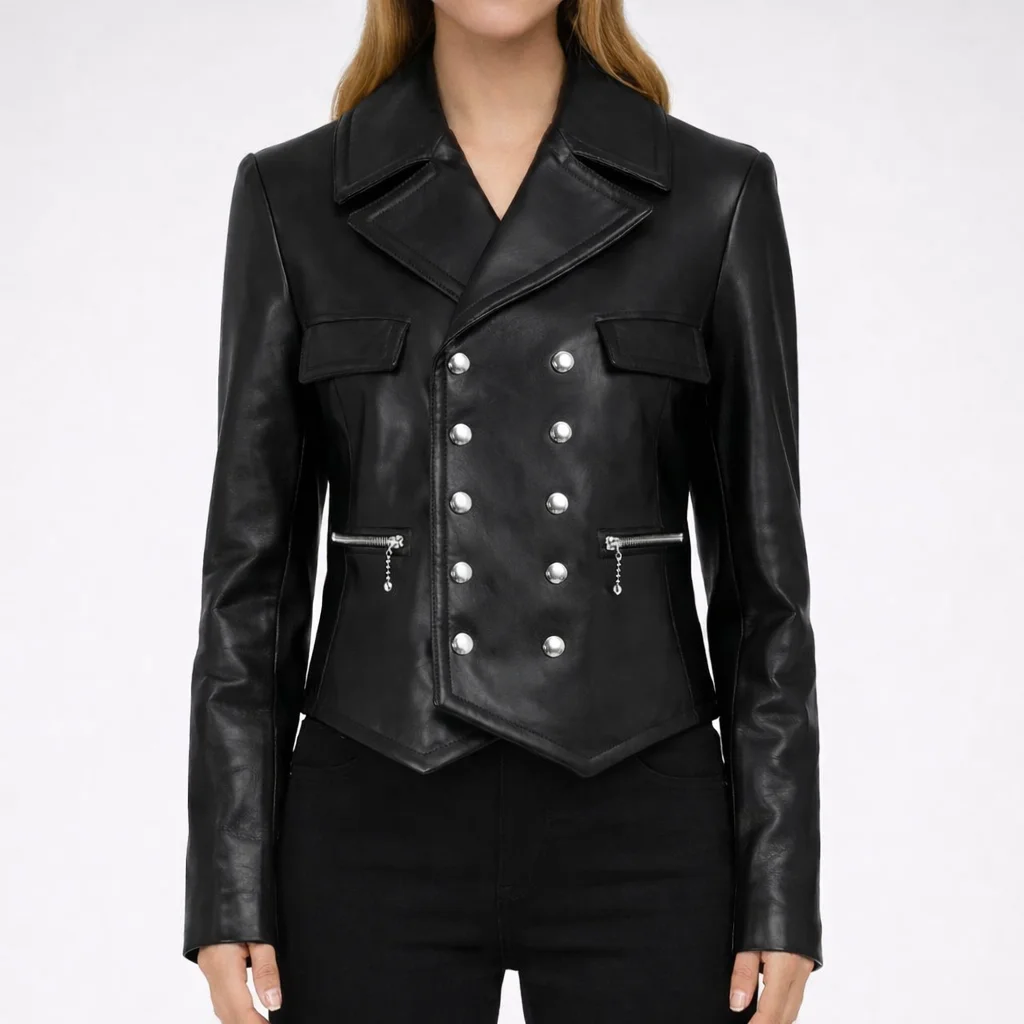
ALICE Black Leather Jacket For Women
Price range: $299.00 through $329.00 -
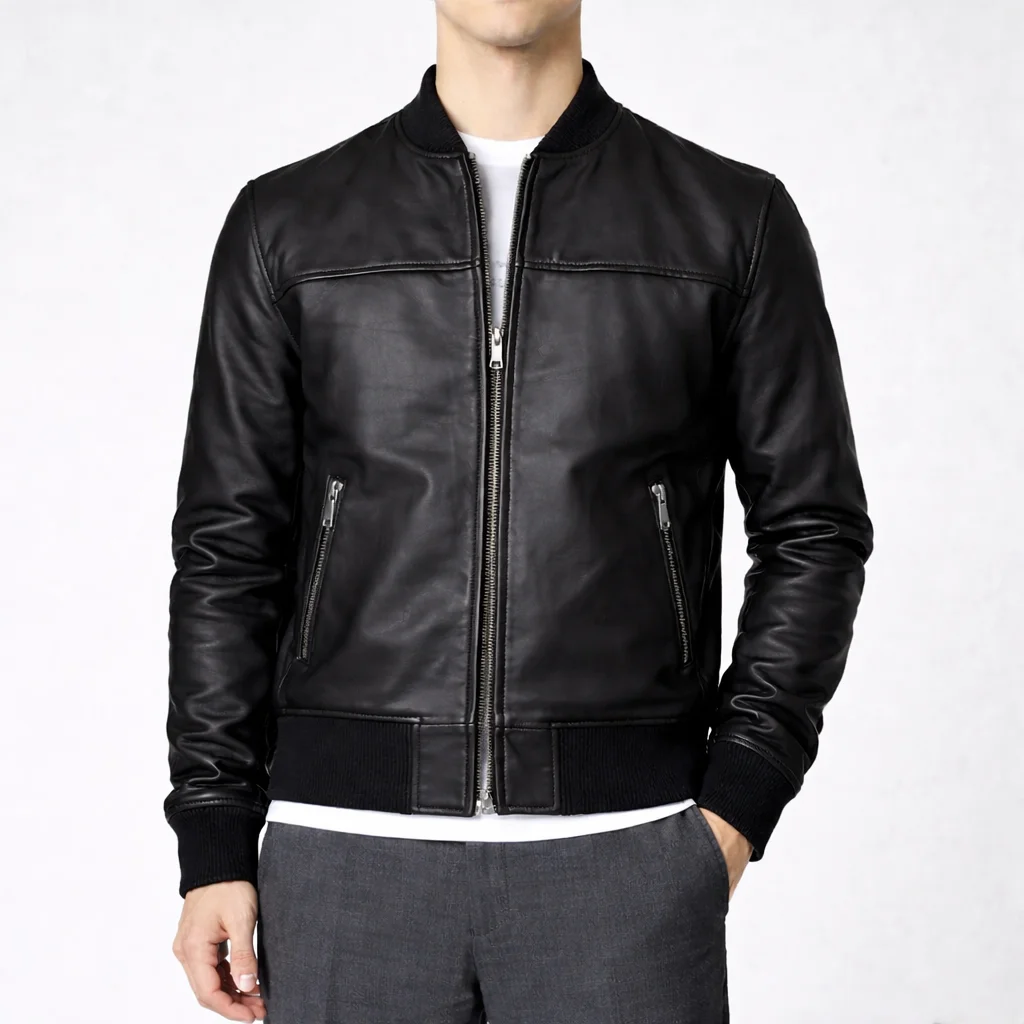
ALVIN Black Leather Bomber Jacket For Men
Price range: $299.00 through $329.00 -
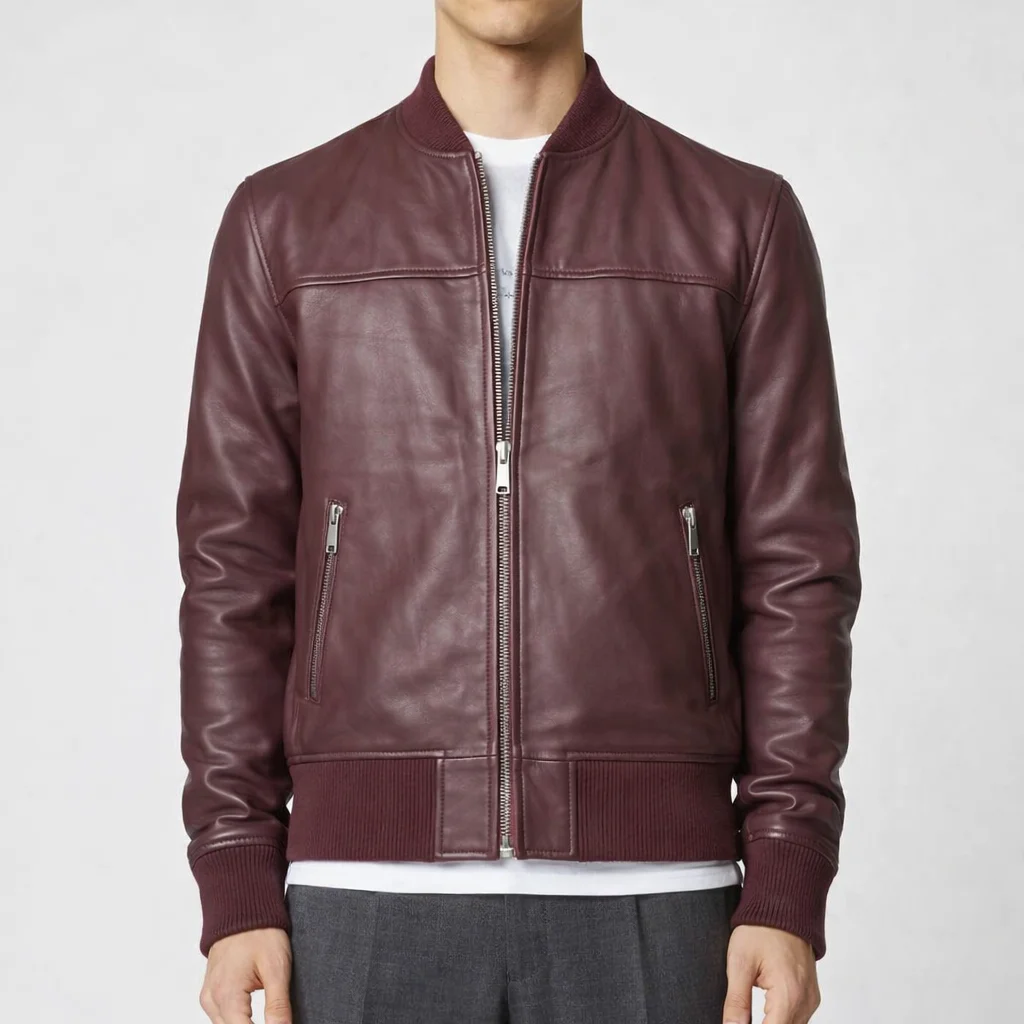
ALVIN Burgundy Leather Jacket For Men
Price range: $299.00 through $329.00
Bonded Leather vs. Faux Leather (PU/PVC Leather)
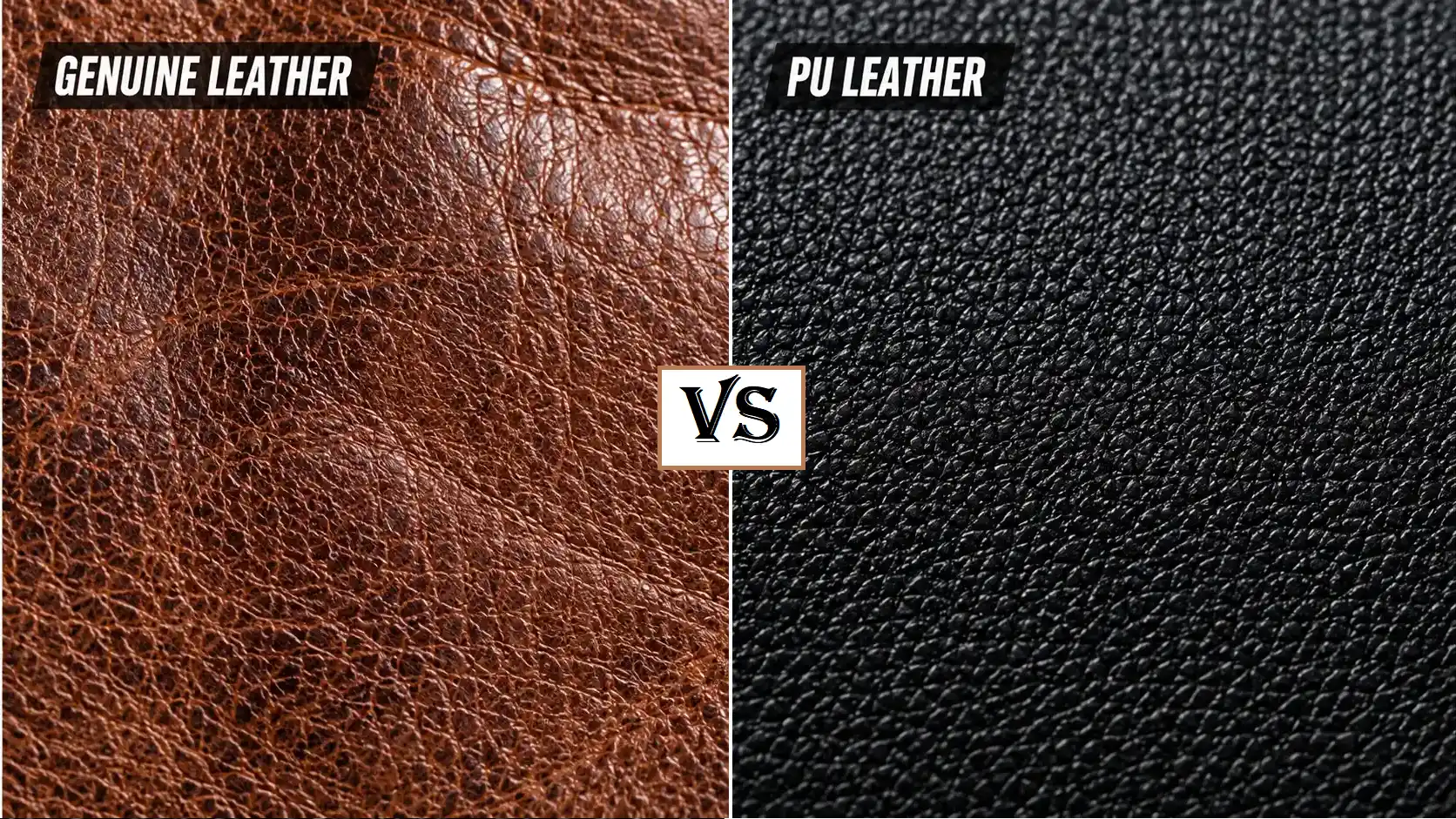
People often lump bonded leather and faux leather together, but they aren’t the same thing. Faux leather (PU or PVC leather) is 100% synthetic no real leather fiber is involved at all. Bonded leather, on the other hand, does contain a small percentage of genuine leather pulp mixed with synthetic binders.
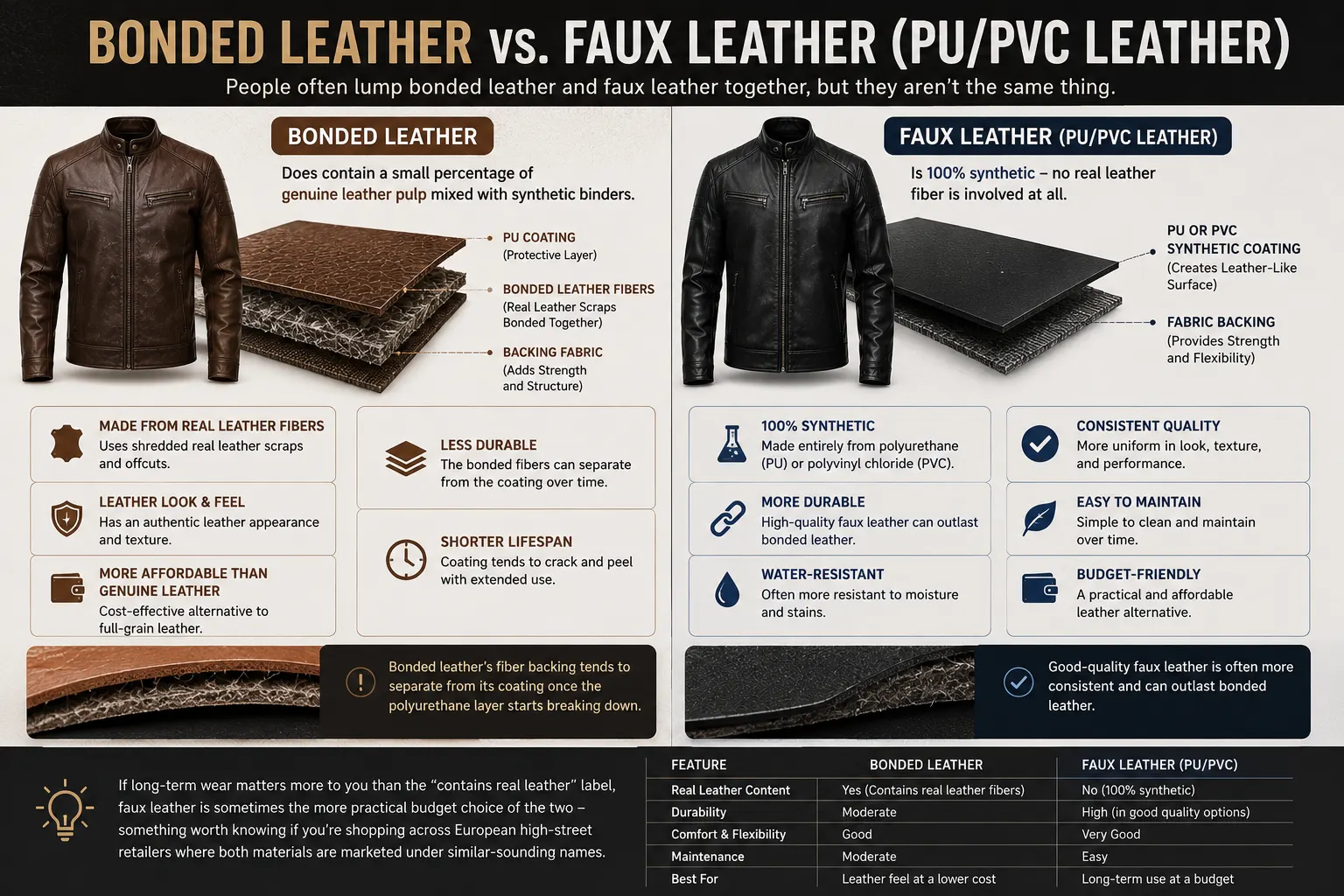
In practice, this distinction doesn’t always work in bonded leather’s favour. Good-quality faux leather is often more consistent and can outlast bonded leather, because bonded leather’s fiber backing tends to separate from its coating once the polyurethane layer starts breaking down. If long-term wear matters more to you than the “contains real leather” label, faux leather is sometimes the more practical budget choice of the two something worth knowing if you’re shopping across European high-street retailers where both materials are marketed under similar-sounding names.
How to Identify Bonded Leather Before You Buy
Since bonded leather is designed to imitate real hide, it helps to know what to check before making a purchase:
- Check the label: Genuine leather items are almost always labeled clearly as “genuine,” “full-grain,” or “top-grain” leather. If a jacket only says “leather” with no further qualifier, be cautious.
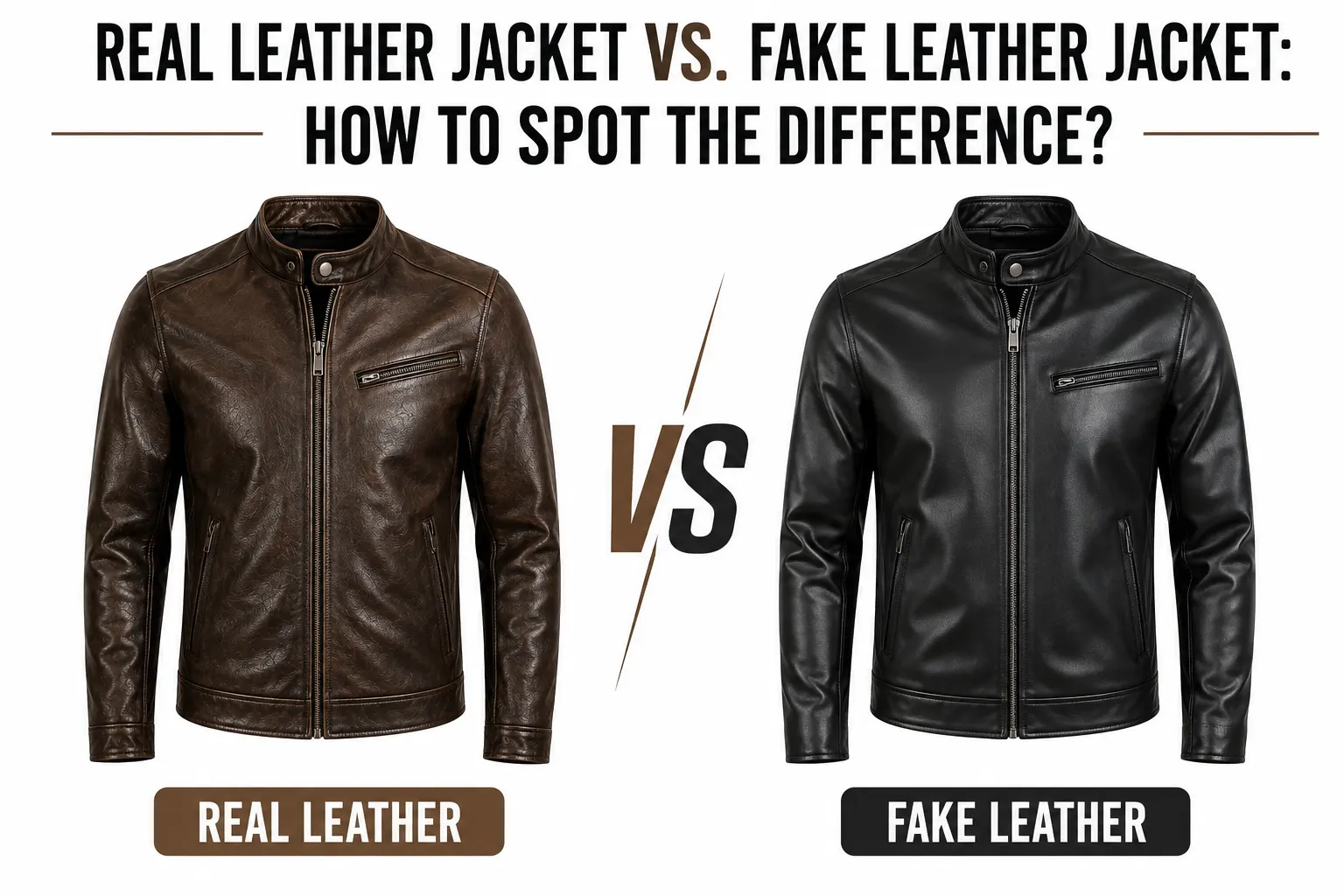
- Examine the edges: Bonded leather has a smooth, perfectly uniform cut edge. Real leather edges look slightly rougher and more natural, since they come from an actual hide rather than a poured sheet.
- Look at the grain pattern: If the texture repeats identically across the entire jacket, it’s manufactured real hide never repeats its grain pattern exactly.
- Do the bend test: Fold the material slightly. Bonded leather often shows a lighter crease or slight whitening at the fold line because of its coating; genuine leather flexes more naturally.
- Smell it: Real leather has a distinct, earthy, organic smell. Bonded leather usually smells faintly chemical or has almost no smell at all.
Bonded Leather and EU/UK Labelling Rules
European shoppers have a slight advantage here that’s worth knowing about. While there isn’t one single EU-wide law covering how all leather clothing must be labelled, footwear across the EU is regulated under Directive 94/11/EC, which sets a clear legal line: a material can only be called “leather” if any surface coating applied to it is no thicker than 0.15mm and no more than one-third of the material’s total thickness. Anything beyond that has to be described as “coated leather” rather than plain “leather.”
Several individual EU countries Germany and Austria among them go further and apply similar labelling standards to leather clothing and accessories, not just shoes, requiring clear identification of material composition and care instructions on the garment itself. The UK, since leaving the EU, has retained equivalent rules under its own consumer protection framework.
The practical takeaway for shoppers in Europe: always look for a clear material tag rather than relying on the word “leather” alone in a product title. Reputable European and UK retailers will specify “genuine leather,” “full-grain leather,” “bonded leather,” or “faux leather” explicitly, because mislabelling can fall foul of consumer protection law in several member states.
Where Else Is Bonded Leather Used?
Jackets aren’t the only place you’ll find this material. Bonded leather is common in:
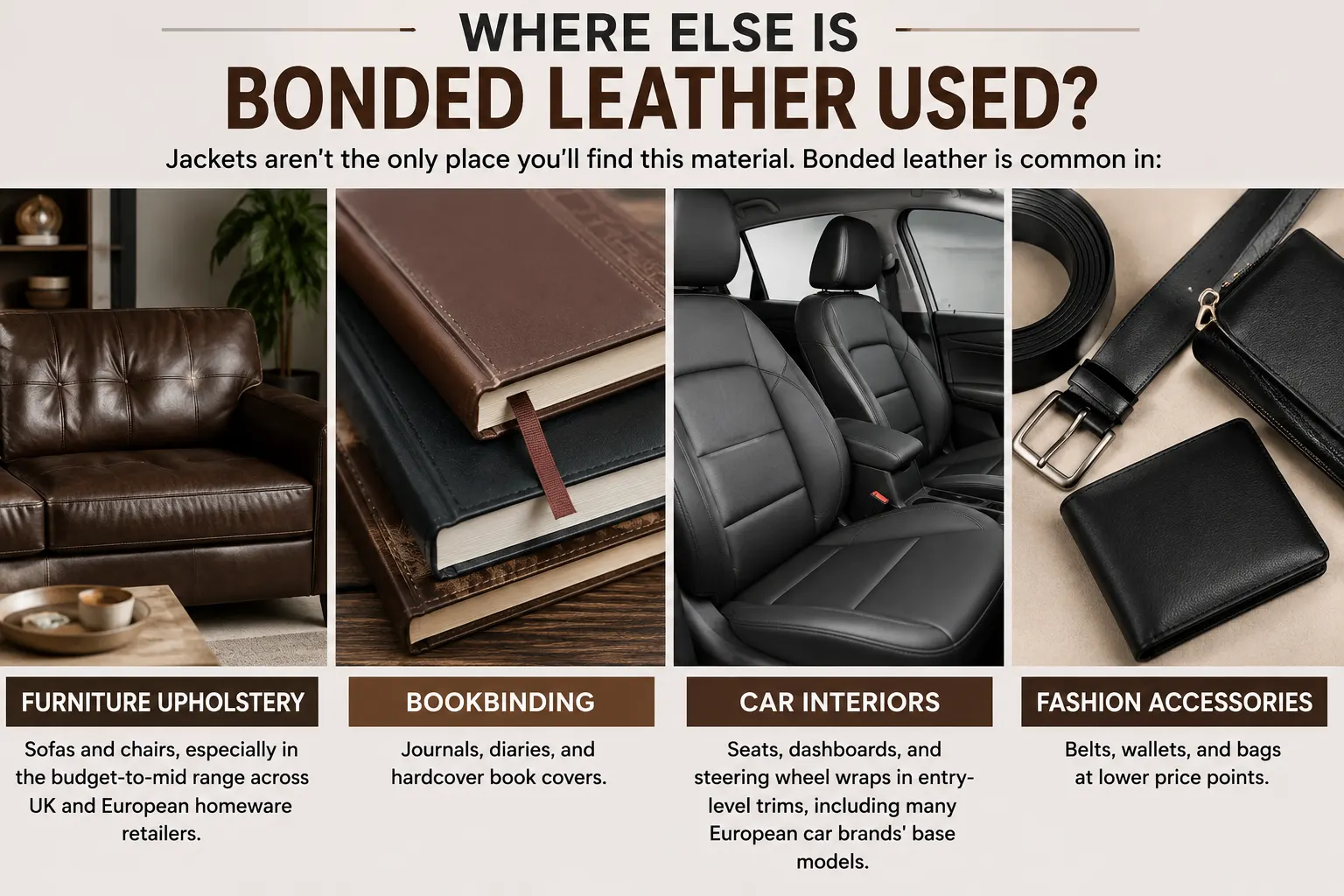
- Furniture upholstery sofas and chairs, especially in the budget-to-mid range across UK and European homeware retailers.
- Bookbinding journals, diaries, and hardcover book covers.
- Car interiors seats, dashboards, and steering wheel wraps in entry-level trims, including many European car brands’ base models.
- Fashion accessories belts, wallets, and bags at lower price points.
How Bonded Leather Performs in European Weather
Climate matters more than most buyers expect. Europe’s weather varies hugely from the damp, rainy winters of the UK and Ireland, to the freezing cold of Scandinavia and Central Europe, to the milder, drier conditions of Southern Europe like Spain, Italy, and Greece. Bonded leather doesn’t handle these conditions consistently:
- Cold Northern and Central Europe (UK, Germany, Poland, Scandinavia): Low temperatures make the polyurethane coating on bonded leather stiffer and more brittle, which speeds up cracking, especially at fold points like elbows and cuffs.
- Damp, rainy climates (UK, Ireland, Netherlands, Belgium): Frequent moisture exposure weakens the adhesive bond between the fiber backing and coating, causing the surface to lift and peel faster than in drier regions.
- Mild, dry Southern Europe (Spain, Italy, Southern France, Greece): Bonded leather tends to last somewhat longer here, though direct sun exposure over time still degrades the coating.
Genuine leather, by contrast, is far more weather-resilient across all of these climates. It absorbs and releases moisture naturally, flexes without cracking in the cold, and can be conditioned to restore water resistance something bonded leather simply cannot do once its coating starts to fail.
Why Some People Still Buy Bonded Leather Jackets in Europe
Despite its limitations, bonded leather has a real place in the European market. The biggest draw is straightforward affordability it lets someone get the look of a leather jacket at a fraction of the cost of full-grain or top-grain leather, which matters in high-cost-of-living cities like London, Paris, or Zurich. It also appeals to people who want a jacket for a single season, a costume, festival wear, or a short-term style experiment, where long-term durability isn’t the priority.
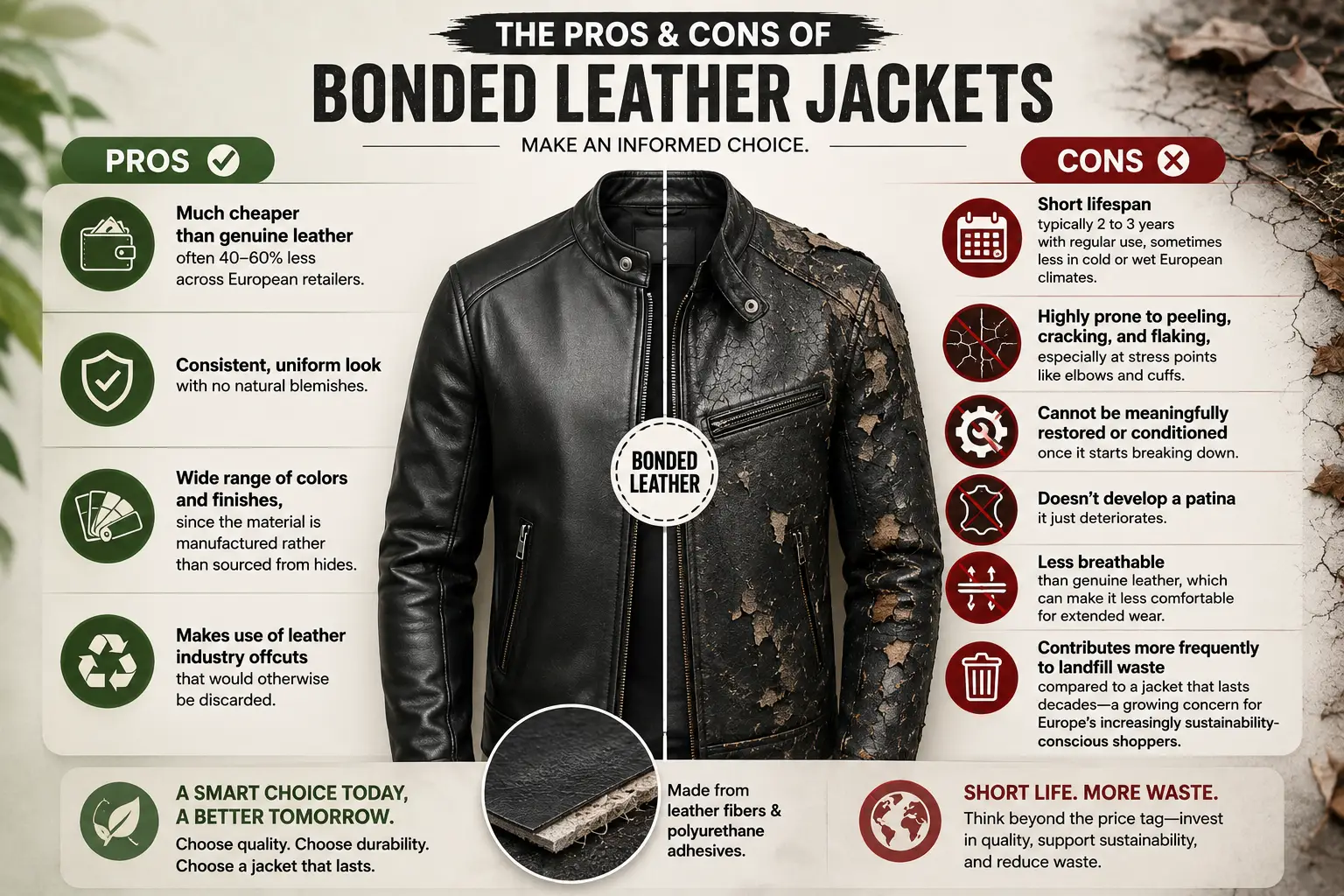
Pros of Bonded Leather Jackets
- Much cheaper than genuine leather often 40–60% less across European retailers.
- Consistent, uniform look with no natural blemishes.
- Wide range of colors and finishes, since the material is manufactured rather than sourced from hides.
- Makes use of leather industry offcuts that would otherwise be discarded.
Cons of Bonded Leather Jackets
- Short lifespan typically 2 to 3 years with regular use, sometimes less in cold or wet European climates.
- Highly prone to peeling, cracking, and flaking, especially at stress points like elbows and cuffs.
- Cannot be meaningfully restored or conditioned once it starts breaking down.
- Doesn’t develop a patina it just deteriorates.
- Less breathable than genuine leather, which can make it less comfortable for extended wear.
- Because of its short lifespan, it contributes more frequently to landfill waste compared to a jacket that lasts decades a growing concern for Europe’s increasingly sustainability-conscious shoppers.
How Long Do Bonded Leather Jackets Actually Last?
On average, a bonded leather jacket holds up for about 2 to 3 years under regular wear, though this varies with climate, handling, and how often it’s worn. In colder, wetter parts of Europe, that lifespan often lands at the lower end of the range. High-friction areas elbows, cuffs, and shoulders where straps or bags rub tend to show peeling first. Once the polyurethane coating starts to crack, the damage is usually irreversible, since there’s no natural fiber structure underneath to condition or repair.
Caring for a Bonded Leather Jacket
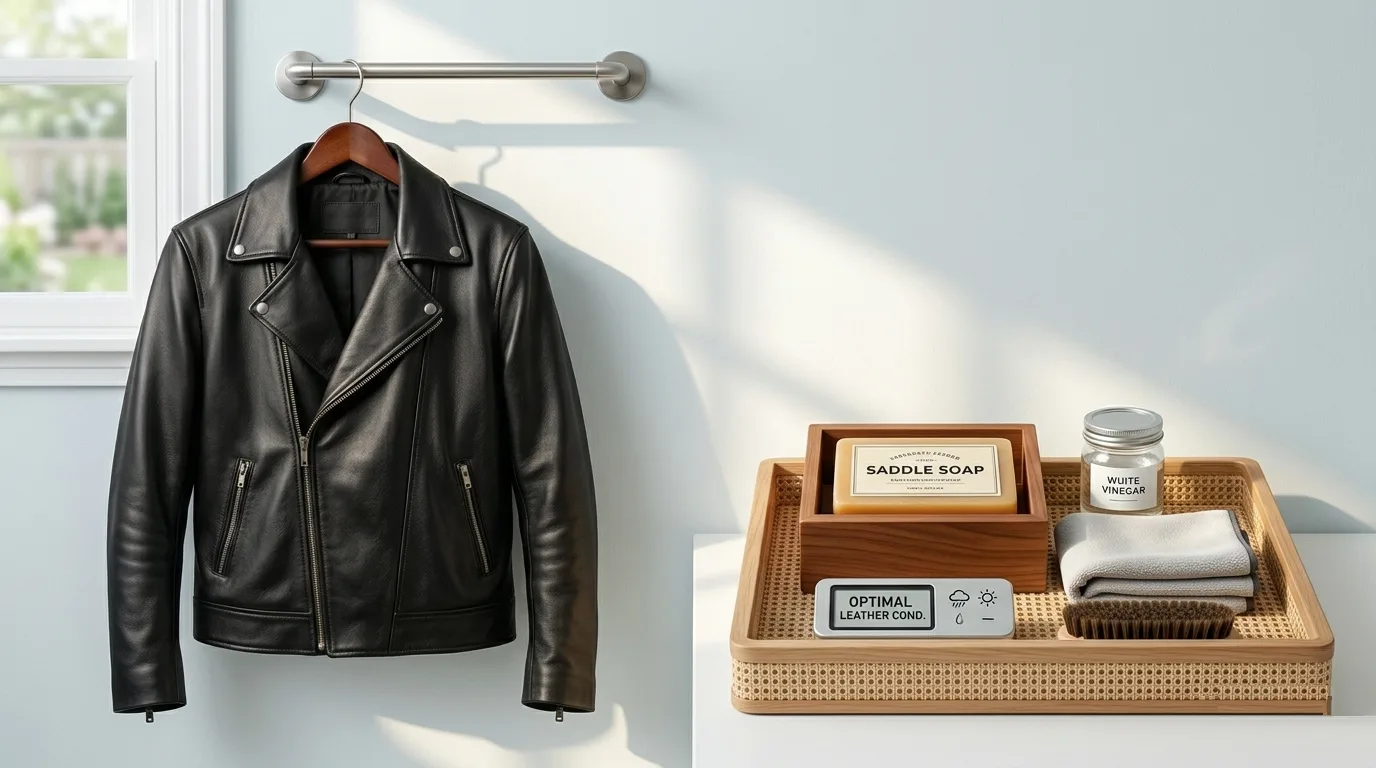
Bonded leather can’t be treated like genuine leather, but a few habits can slow down the wear especially important if you live somewhere with a damp or cold European climate:
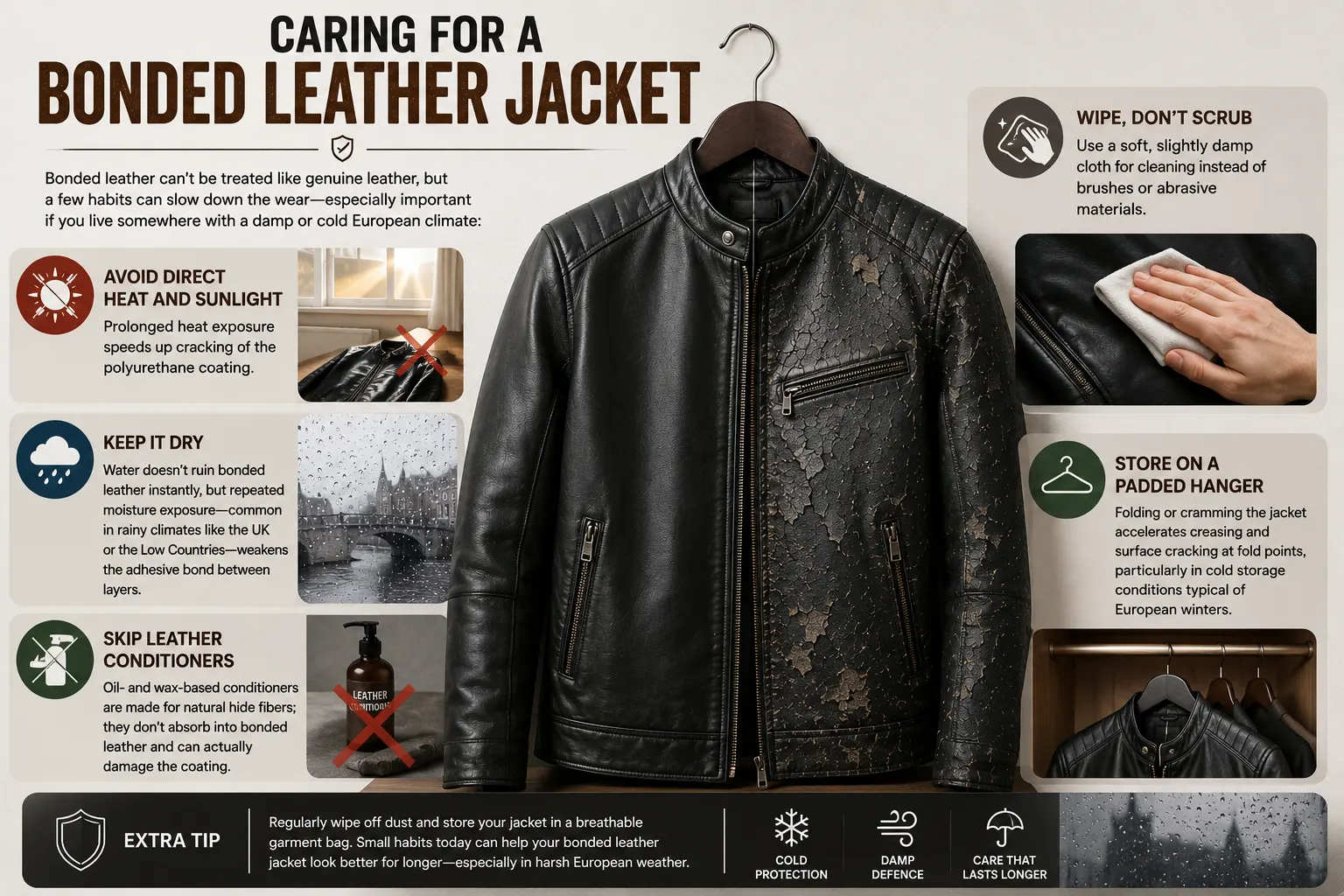
- Avoid direct heat and sunlight: Prolonged heat exposure speeds up cracking of the polyurethane coating.
- Keep it dry: Water doesn’t ruin bonded leather instantly, but repeated moisture exposure common in rainy climates like the UK or the Low Countries weakens the adhesive bond between layers.
- Skip leather conditioners: Oil- and wax-based conditioners are made for natural hide fibers; they don’t absorb into bonded leather and can actually damage the coating.
- Wipe, don’t scrub: Use a soft, slightly damp cloth for cleaning instead of brushes or abrasive materials.
- Store on a padded hanger: Folding or cramming the jacket accelerates creasing and surface cracking at fold points, particularly in cold storage conditions typical of European winters.
Is Bonded Leather Environmentally Friendly?
This is a genuinely mixed picture, and it matters more to European buyers than most other markets, given how strongly sustainability now factors into EU consumer habits. On the positive side, bonded leather reuses scraps and offcuts from leather production that would otherwise be thrown away, which in theory reduces manufacturing waste. On the negative side, its short lifespan means bonded leather products get discarded far more often than genuine leather goods, which can offset that initial waste reduction. A full-grain leather jacket that lasts 20+ years ultimately has a smaller footprint per year of use than a bonded leather jacket that needs replacing every couple of years an important consideration under the EU’s broader push toward sustainable and durable consumer goods.
Should You Buy a Bonded Leather Jacket?
It depends on what you actually need from the jacket:
- Buy bonded leather if: you want a low-cost jacket for occasional or seasonal wear, you’re experimenting with a style before committing to a real leather piece, or budget is the primary constraint.
- Avoid bonded leather if: you live in a cold or wet European climate, want a jacket that lasts for years, ages well, and can be repaired or conditioned in that case, genuine leather is the better long-term investment.
Better Alternatives to Bonded Leather
If longevity matters to you especially through European autumns and winters consider these instead:
- Full-Grain Leather: The highest quality option, using the entire, unaltered top layer of the hide. Ages beautifully and develops a rich patina, and holds up exceptionally well across all European climates.
- Top-Grain Leather: Slightly sanded to remove imperfections still highly durable and more affordable than full-grain.
- Genuine Leather: Made from lower layers of the hide. Still real leather and far more durable than bonded leather, at a moderate price point.
- Faux Leather: Fully synthetic, but often more consistent and longer-lasting than bonded leather for the price useful for milder Southern European climates or occasional wear.
Buying Leather Jackets from Europe: What Shoppers Should Know
Shoppers across the UK, Germany, France, Italy, Spain, the Netherlands, and other European countries increasingly buy leather jackets online, which makes understanding material quality even more important since you can’t physically inspect the product beforehand. A few tips specific to shopping from within Europe:
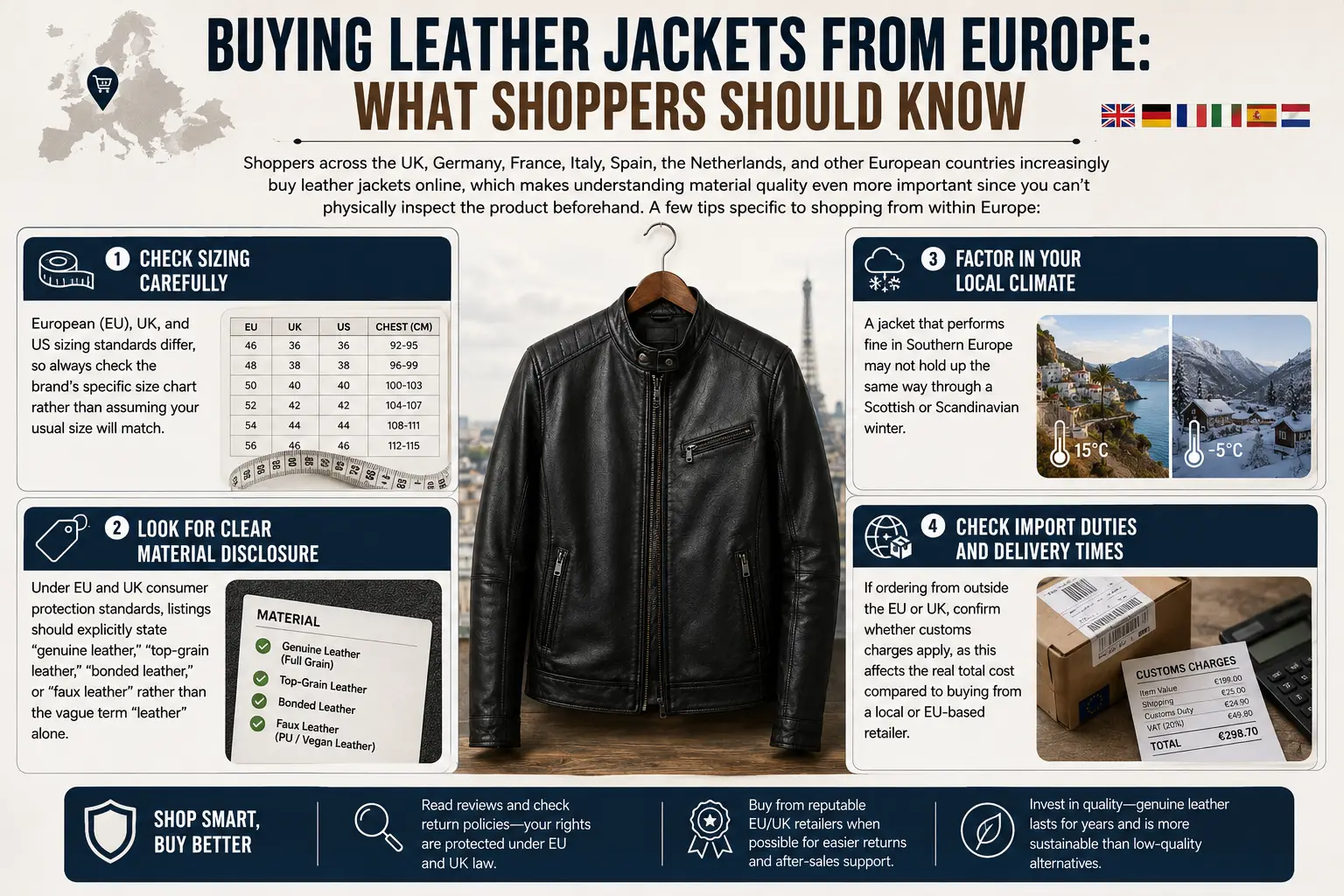
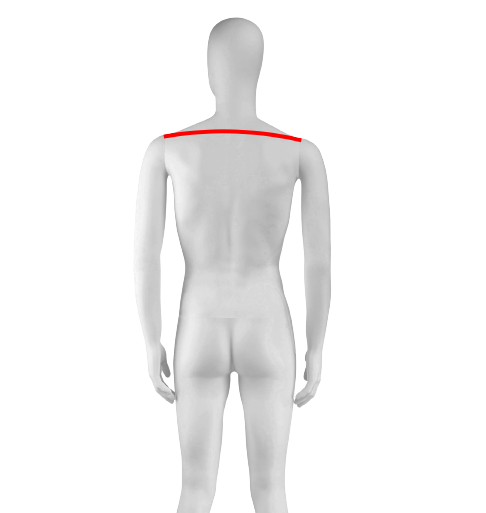
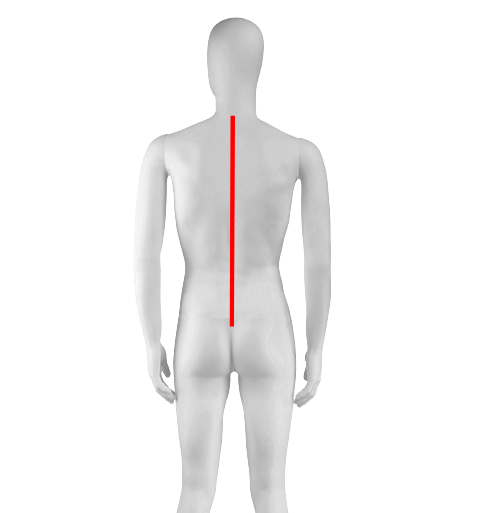
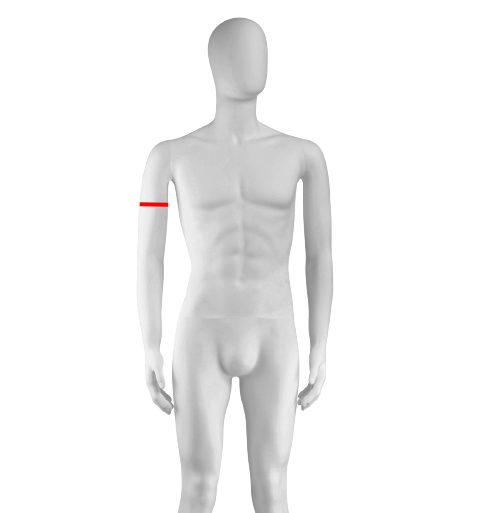
- Check sizing carefully: European (EU), UK, and US sizing standards differ, so always check the brand’s specific size chart rather than assuming your usual size will match.
- Look for clear material disclosure: Under EU and UK consumer protection standards, listings should explicitly state “genuine leather,” “top-grain leather,” “bonded leather,” or “faux leather” rather than the vague term “leather” alone.
- Factor in your local climate: A jacket that performs fine in Southern Europe may not hold up the same way through a Scottish or Scandinavian winter.
- Check import duties and delivery times: If ordering from outside the EU or UK, confirm whether customs charges apply, as this affects the real total cost compared to buying from a local or EU-based retailer.
Frequently Asked Questions
Q1: Do bonded leather jackets last long?
No. Most bonded leather jackets hold up for around 2 to 3 years of regular wear before peeling or cracking becomes noticeable, often less in cold or damp European climates.
Q2: Are bonded leather jackets waterproof?
They can handle light splashes reasonably well, but sustained moisture exposure common in rainy parts of Europe like the UK, Ireland, and the Low Countries weakens the adhesive layer over time and shortens the jacket’s lifespan.
Q3: Do bonded leather jackets crack?
Yes, cracking and peeling are the most common and expected forms of wear, usually starting at high-friction points like elbows and cuffs, and accelerated by cold weather.
Q4: Can bonded leather be conditioned like real leather?
Not effectively. Since bonded leather lacks the natural fiber structure of real hide, oil- and wax-based conditioners don’t absorb properly and can even damage the surface coating.
Q5: Is bonded leather the same as faux leather?
No. Bonded leather contains a small percentage (roughly 10–20%) of real leather fiber mixed with synthetic binders, while faux leather is entirely synthetic with no leather content at all.
Q6: How can I tell if a jacket is bonded leather before buying?
Check the label, examine the cut edges for uniformity, look for a repeating grain pattern, and smell it bonded leather usually lacks the natural, earthy scent of real hide.
Q7: Are there EU rules requiring bonded leather to be labelled clearly?
There’s no single EU-wide law covering all leather clothing, but footwear is regulated under Directive 94/11/EC, and several countries such as Germany and Austria apply similar material-labelling standards to leather clothing. Reputable European retailers generally disclose material type clearly regardless.
Q8: Is bonded leather suitable for cold European winters?
Not ideally. Cold temperatures make the coating on bonded leather stiffer and more prone to cracking, so it performs noticeably worse than genuine leather in Northern and Central European winters.
Q9: Is bonded leather worth the lower price?
For short-term or occasional wear, yes it offers the leather look at a fraction of the cost. For a long-term wardrobe investment, especially in a colder European climate, genuine or full-grain leather offers far better value over time.
Q10: Should I buy a bonded leather jacket?
If you want a budget-friendly jacket for short-term fashion use, bonded leather can work. But if you’re after durability, natural ageing, and long-term value particularly if you live somewhere with real winters genuine leather is the better choice.
Final Thoughts
Bonded leather jackets are stylish and easy on the wallet, but they simply aren’t built for the long run and that’s especially true across Europe’s colder and wetter climates, where the material’s weaknesses show up faster than in milder regions. They work well as an entry-level option for anyone who wants the leather look without a big upfront cost just go in with realistic expectations about how long the jacket will hold up. For durability, natural character, and a piece you can wear for years and pass down, genuine leather remains unmatched.
At Lammberg, we believe in transparency and helping our customers across Europe and beyond make informed decisions. Explore our full collection of full-grain and genuine leather jackets, built to handle real European weather, at lammberg.com.





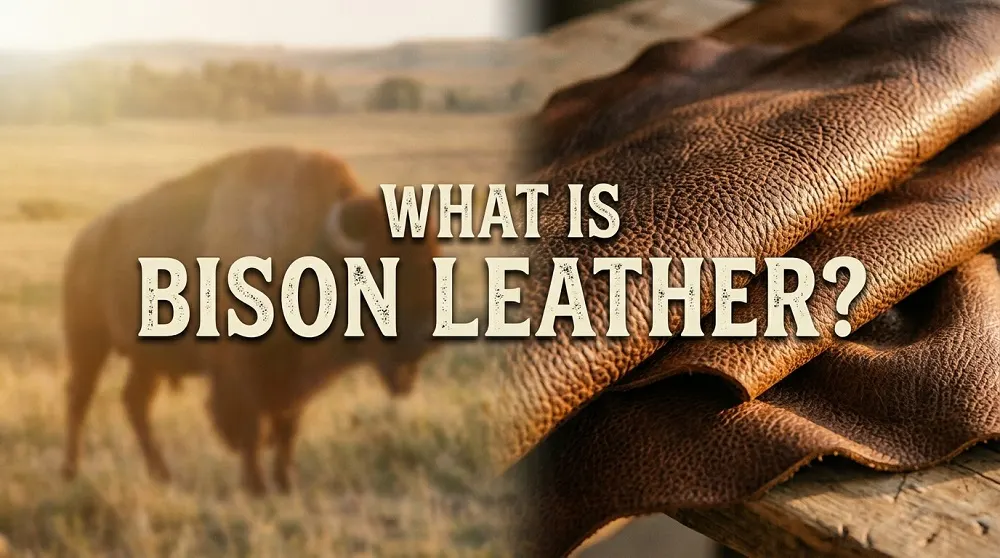
What Is Bison Leather? Durability, Uses & Cowhide Comparison
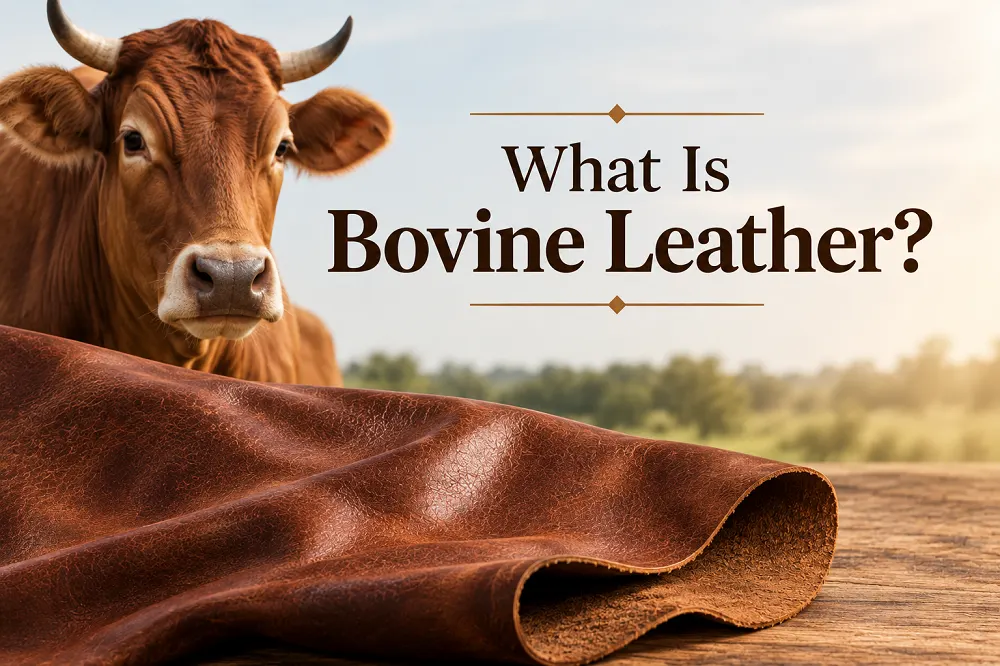
What Is Bovine Leather?